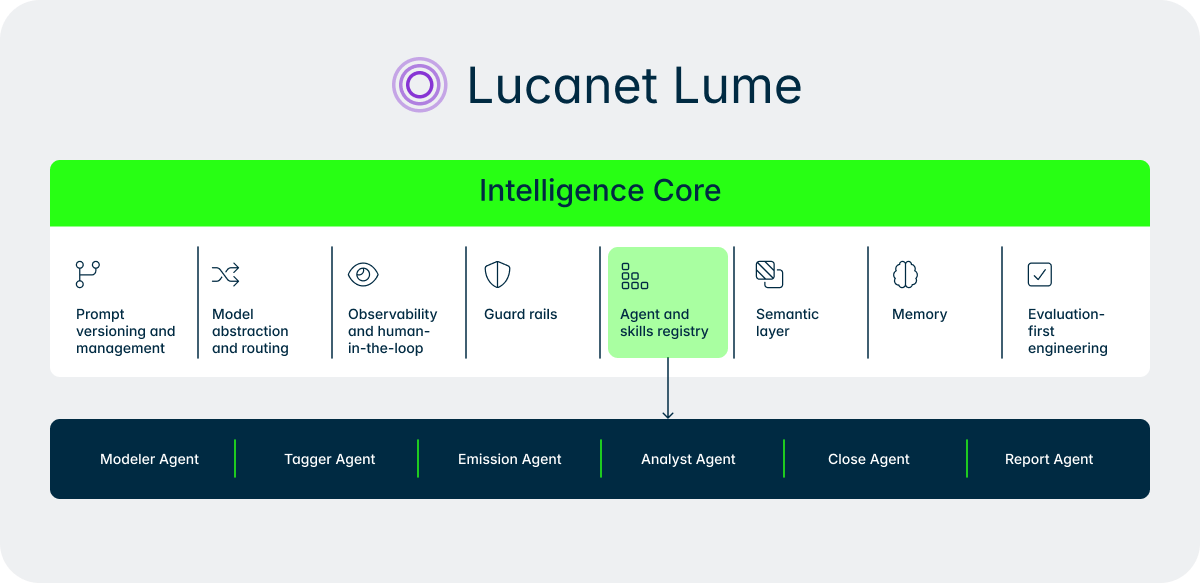
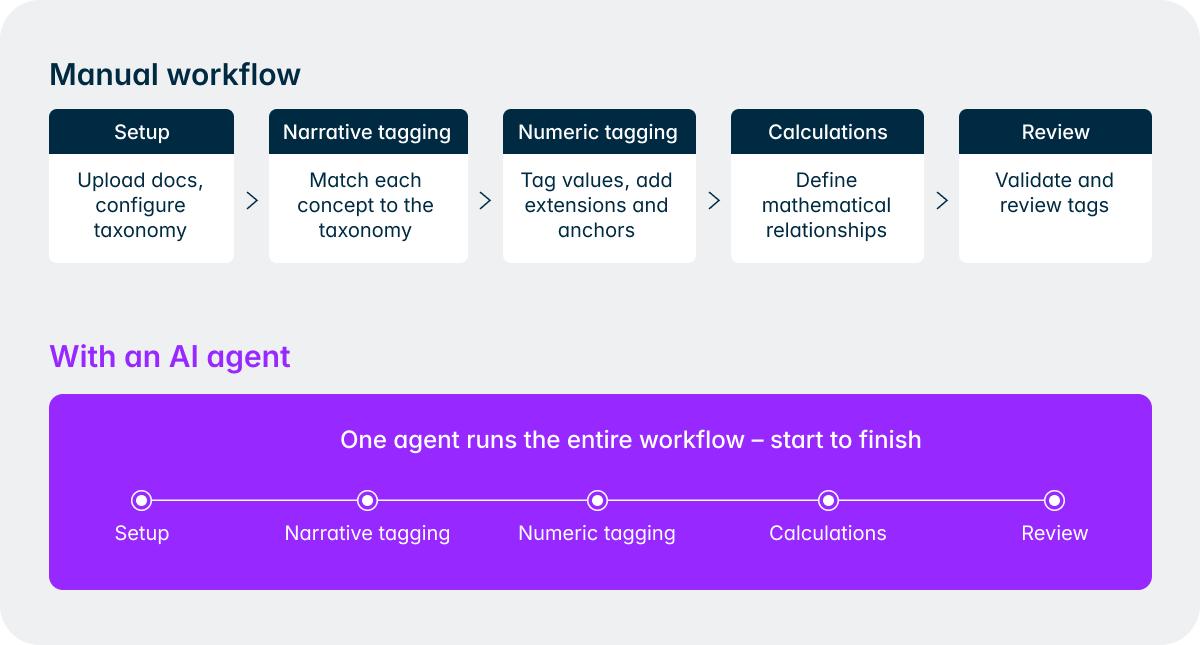
That step-by-step nature is exactly why the Intelligence Core matters. As we explained when we unpacked our trust architecture, if each step in a long chain were only 90% accurate, accuracy after ten steps would compound down to roughly a third – unacceptable in our domain.
The Intelligence Core is what keeps that from happening: evaluations that drive quality up systematically, observability that turns the agent's reasoning from a black box into a glass box, deterministic tools that perform every calculation so no number ever comes from a language model's guess, guardrails that catch misuse and a human-in-the-loop design that keeps you in control at every checkpoint.
And as we've said before, trust isn't granted on day one. Each workflow agent earns it the way a new hire does – through repeated interaction, visible improvement and consistent reliability – while the quality flywheel drives its performance up release after release. Every workflow agent in the family inherits these properties because every workflow agent is built on the same core.
With that grounding, let us introduce you to some of the newest members of our family of agents.
Modeler Agent
The hardest moment in any planning tool is the empty page.
The Modeler Agent, born on the Intelligence Core on the platform and deploying its full potential inside xP&A, turns a plain-language description into a complete, editable financial model. You describe what you want – a three-year SaaS revenue model with monthly granularity, ARR snowball and churn assumptions - and the agent proposes a plan, generates the model and hands it back to you fully editable.
It works the way the Intelligence Core prescribes. It discovers your intent from the prompt, presents a structured plan you can review and revise before anything is built, builds the model with visible progress at each step and hands you a normal xP&A model where every cell, dimension, and formula is editable. Intelligence is used to create the model; the output runs on deterministic logic. For new users, it removes the steepest part of the learning curve; for experienced modelers, it eliminates the repetitive scaffolding at the start of every project.
Analyst Agent
The Analyst Agent turns the monthly reporting scramble into a strategic exercise. Sitting on the Intelligence Core, it's drawing together financial data, operational models and external sources across the platform, helping finance teams explain the large majority of performance variances with clear root causes – complex analysis work that used to take days, compressed into a few simple prompts.
It follows the same transparent pattern. It plans together with you, proposing which metrics to examine against budget, forecasts and/or prior year. It validates hypotheses, presenting possible drivers for you to confirm or redirect based on your business knowledge. Then it delivers insights, performing deep-dive analysis on the paths you've approved, generating visualizations and dashboards and drafting narratives you can refine for your audience.
Every conclusion links back to its source data and calculation, so you can verify the reasoning rather than take it on faith. It amplifies the team's expertise; it doesn't replace the judgment that only a finance professional brings.
Close Agent
The Close Agent takes on the data-heavy early stages of the monthly close: the repetitive import setup, the validation checks, the correction chasing that consumes the first days of every cycle.
Built into the platform and rooted in the Intelligence Core, its initial skills automatically create data imports, validate financial data against rules you define in plain language, and orchestrate correction workflows with the right contributors.
It is sensible by design: when uncertain, it asks rather than assumes, and it keeps a complete audit trail that explains every action in plain language and links to the underlying data. It also reflects a principle we'll see more of – graduated autonomy. You choose how much oversight you want, from supervised, where you approve everything, to balanced, to fully autonomous for routine work once trust is established. You can change that setting at any time, and control always stays with you. Early pilots report up to 40% reductions in close time on our platform, without compromising the audit trail.
No new product to learn, just a new colleague to work with
There's a temptation, when a category gets this much attention, to make agents feel like a separate product - a new place to go, a new thing to learn, a break from how you already work.
We've deliberately gone the other way. On the platform, working with one of our workflow agents feels like following the same well-known path you already know, with the same familiar logic – the only difference being that you now have a knowledgeable companion walking it with you.
You don't leave the close process to "use the Close Agent"; you run your close, and the workflow agent is there. No switching into a separate modelling tool; you build your model, and the Modeler Agent meets you there. Of course, you can suggest the desired format of how you'd like a specific chart to look like, or you can let the Analyst Agent suggest a full dashboard based on your context.
The path is the one you've always followed.
What changes is how much you choose to delegate. You decide the level of agency you grant – from reviewing and approving each step, to handing off routine work, all the way to full end-to-end autonomy once an agent has earned that trust – and you can adjust it whenever you like.
The workflow agents' competence grows through the quality flywheel; the authority it holds is always yours to set. That's the shape of working with our family of agents: a familiar path, a capable companion and a level of delegation you control.
How you'll reach them: Lucanet Lume
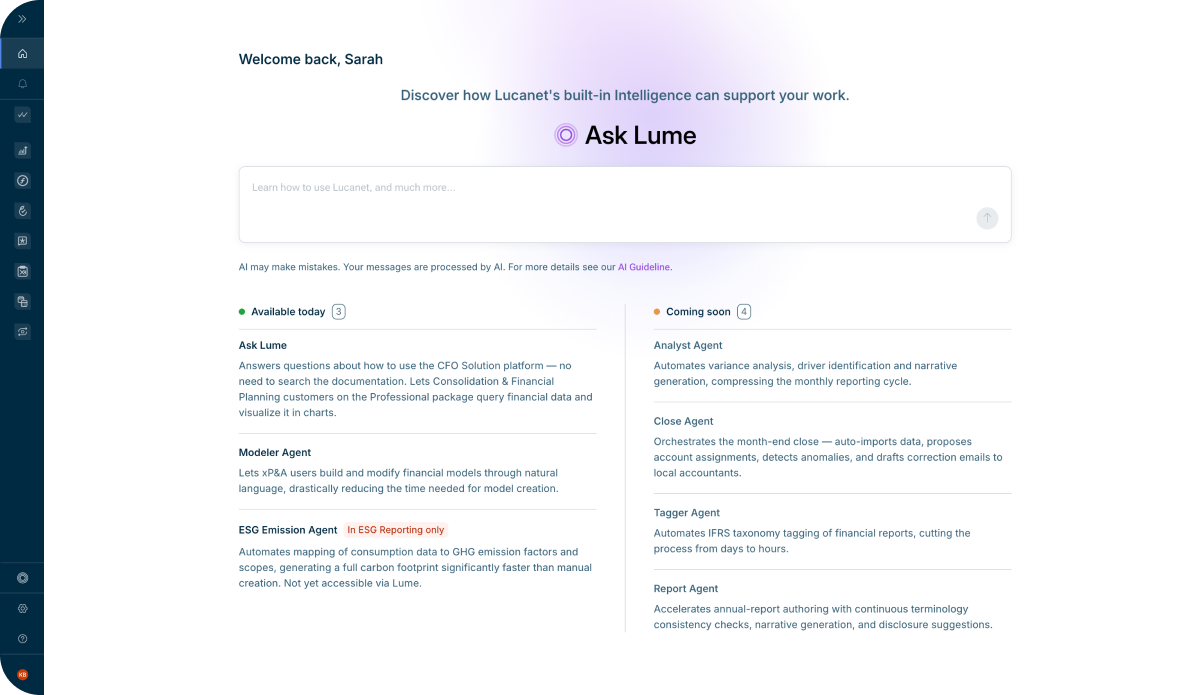
These three workflow agents do very different jobs, but they are deliberately members of one family rather than three separate products. They share the Intelligence Core, so they share the same guarantees. And you'll reach them all through one consistent interface: Lucanet Lume.
As we covered in detail in a previous article in this series, we are moving away from the term “copilot” to describe our conversational layer. The short version: the arrival of agents changed what the conversational layer actually does. A copilot assists from the side. Lucanet Lume is the entry point to a system that plans, reasons, calls deterministic calculation engines and orchestrates multi-step workflows across the platform. The name had to catch up with the architecture.
What Lucanet Lume means for the family of agents
Lucanet Lume is how you reach every member of the family. You describe what you want in natural language, and Lucanet Lume routes you to the right specialized agent for the job. It also gives the platform a voice to proactively interact with you, remind you of open tasks, suggest actions, and surface relevant insights.