Lucanet’s Data Platform and the semantic layer

Published Jun 04, 2026  | 5 min read
  • Image of Kevin Smith

    Kevin Smith

    CTO, Lucanet

In our last Intelligence inside article, I unpacked the Intelligence Core: the architectural layer in the CFO Solution Platform on top of which all our agents are built, ensuring they inherit the same high standards for quality, observability, control, and safety. 

But intelligent agents alone are not enough. To steer a business, finance and tax teams need a 360-degree view that combines financial data with operational data from across the organization. Most teams today get this view by stitching accounting, ERPs, CRMs, DMS, payroll, HRIS systems, and spreadsheets together, often with a data warehouse side-project, a thin BI layer on top, and a quiet anxiety about whether the numbers in the board pack reconcile to the consolidation. Agents face exactly the same problem. If they cannot find, trust, and understand your data, they cannot do meaningful work for you. 

In this third article, I will unpack the Data Platform, another foundational architectural layer of the CFO Solution Platform, and the semantic layer that sits on top of it, which together give our agents (and your team) a single, governed source of truth to reason over.

Connect once, use everywhere  

For more than 25 years, Lucanet’s consolidation and financial planning solution has acted as a financial data warehouse for our customers, storing financial data down to the transaction level from every accounting system or ERP that feeds the group. In our customer base, the typical medium-to-large business starts with two or three different ERPs, and Lucanet has long been a fast route to a single source of truth across them. That clarity is one of the reasons CFOs choose Lucanet to begin with.

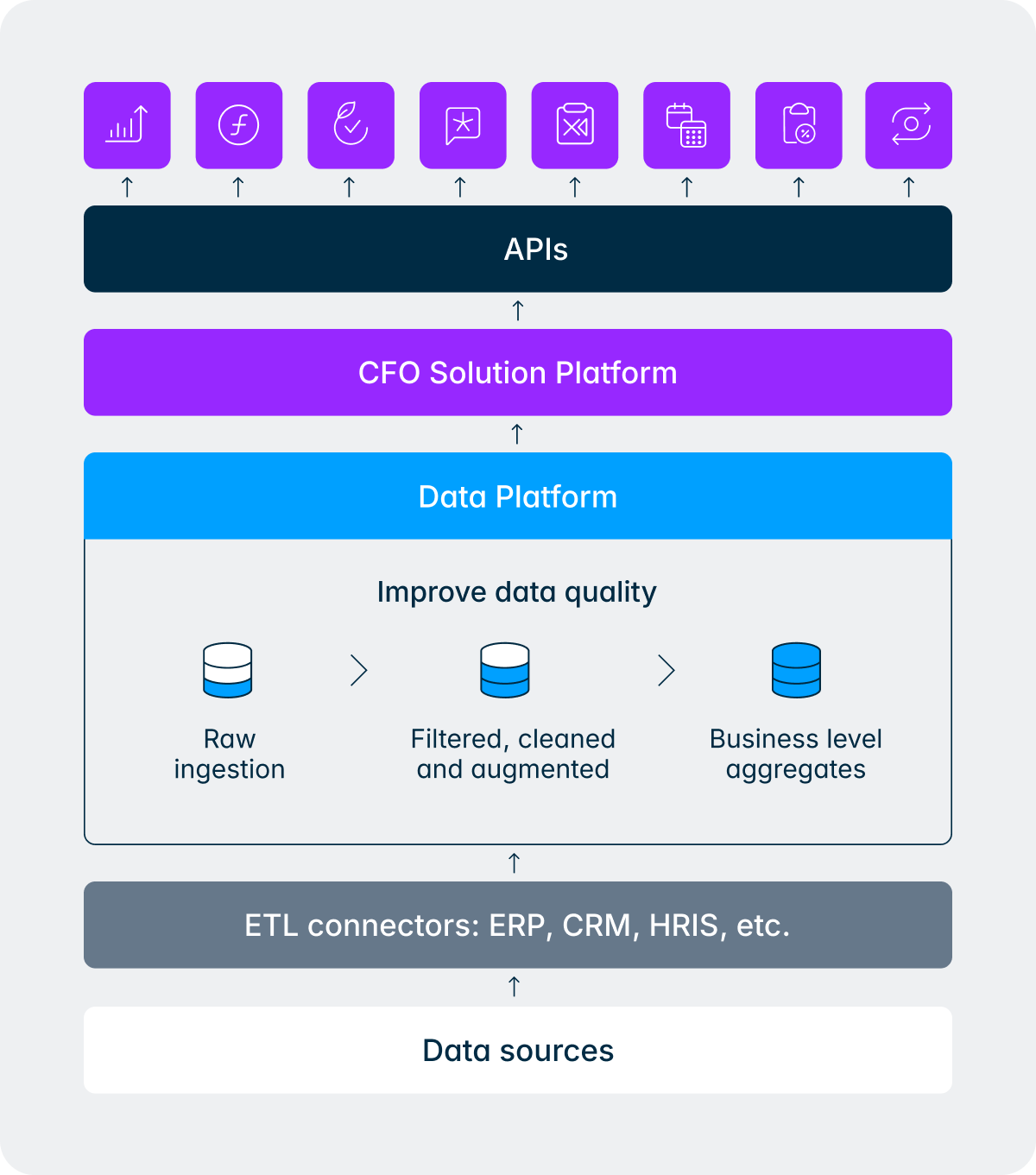
The Data Platform extends that idea well beyond financial data. It is a single source of truth for the office of the CFO, bringing together financial and operational data from source systems that matter to how the business is run. It removes the need for finance and tax teams to commission, integrate, and operate a separate enterprise data warehouse, with all the cost, latency, and reconciliation pain that usually comes with it.

Under the hood, the Data Platform is elastically scalable from gigabytes to petabytes of data, with eleven nines of durability (99.999999999%), the same durability standard offered by the leading public cloud storage tiers. In plain language, the chance of losing a record in storage is effectively zero, and the platform grows quietly with your business rather than constraining it.

Acquiring and cleansing data, with lineage you can defend

A data warehouse is only as good as the data pipelines feeding it. The Data Platform is supported by a vast library of ETL standard connectors, allowing it to connect to virtually any financial or operational source system. Where a connector does not yet exist, we have a dedicated team that builds the required integration, typically within days rather than weeks.

The pipeline itself follows a now-standard medallion architecture: bronze, silver, and gold.

  • Bronze: Data is ingested in its raw form from the source system, untouched, with full audit traceability back to the originating record – even to the invoice PDF document if the according DMS is connected.
  • Silver: Raw data is filtered, cleansed, deduplicated, and enriched, with business rules applied consistently.
  • Gold: Cleansed data is aggregated and shaped to match the financial and operational models the business actually uses to make decisions. This is the layer finance and tax teams use day to day.


Each layer improves the quality of the data, and each transformation is logged. The result is what finance teams care about most: not just a number on a dashboard, but the lineage behind it. Data in the gold layer can be traced back through the silver and bronze layers to the originating record in the source system. 

Because the Data Platform serves every solution on the CFO Solution Platform, the ETL connectors are reused: if you connect a source once for consolidation, your ESG, tax and xP&A use cases will inherit it.


From data to understanding: the semantic layer

A warehouse, however well-fed, is still a collection of tables, columns, naming conventions and join paths. Each source system has its own schema and its own dialect. Asking an agent (or a person) to write the right query across all of that, every time, is exactly the kind of friction that has historically slowed finance teams down.

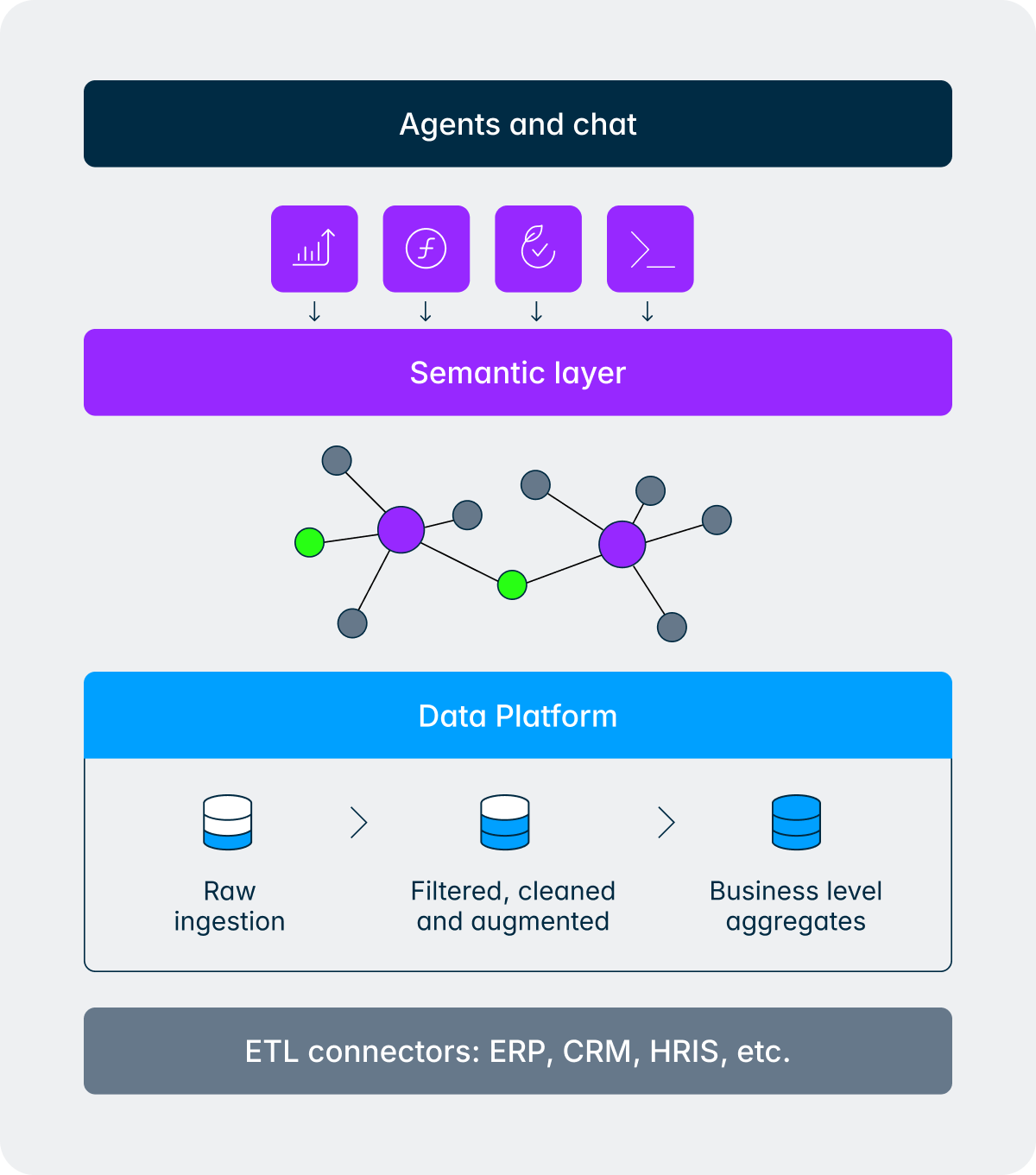
That is the job of the semantic layer. It sits between agents and the Data Platform, and it does what your best analyst does in their head: translates business questions into the right queries against the right data, and returns clean, governed answers. “Current assets for entity X in fiscal year 2026” becomes a precise query, executed against the correct tables, with the correct filters, returning a structured result an agent can reason over.

At the core of the semantic layer is a knowledge graph: a structured representation of every table, column, dimension, metric, and relationship in the customer’s Data Platform. Each customer has their own instance of the semantic layer, automatically tailored to their data. As data is added or changed, the graph is rebuilt on demand so it always reflects the current shape of the business.

The knowledge graph encodes facts as simple subject-predicate-object triples. For our domain, those triples describe the structure of the business and its data, for example:

  • Entity_FR, hasParent, Group_EMEA
  • Account_Revenue, belongsTo, Income_Statement
  • Account_Revenue, isMeasuredIn, EUR
  • Subsidiary_UK, reportsIn, GBP
  • Cost_Centre_42, allocatesTo, Region_NorthernEurope


This structure lets the semantic layer reason across complex relationships through graph traversal, rather than relying on hard-coded query logic. When an agent asks for “revenue in Northern Europe last quarter”, the semantic layer can resolve “Northern Europe” to the right set of entities, “revenue” to the right account hierarchy, “last quarter” to the correct fiscal period, and produce a query that is correct by construction.


How it works in practice

Take a question a CFO might ask the night before a board meeting:

“How did our UK revenue grow last year compared to Germany, and what does sales headcount and new customer count look like in those regions?”


That single question touches accounting data (revenue), operational data (customer data from the CRM), headcount information (from the HRIS), two entities, a year-on-year comparison, and a regional view. Here is how the agent and the semantic layer handle it together:

  1. The user asks the question in natural language.
  2. The agent reasons about what is being asked: which financial concepts, which operational concepts, which dimensions, which time period.
  3. The agent sends one or more data requests to the semantic layer.
  4. The semantic layer traverses the knowledge graph to identify the relevant tables, joins, and dimensions across the financial, HR, and operational data sets.
  5. Dimension resolution translates business terms into specific identifiers (UK and Germany legal entities, correct fiscal year, revenue accounts, headcount category, customer metric definition).
  6. The semantic layer fetches the data, executes the queries against the gold layer, and returns structured results.
  7. The agent uses those results to answer the question, with a chart and a narrative, and the Intelligence Core captures the trace so the user can see exactly how the answer was produced.


What previously took a finance business partner half a day, with a BI ticket and a follow-up reconciliation, now takes seconds. The agent is not guessing. It is asking your data warehouse the right questions, in your own business language.


PhD -level intelligence, but day 1 on the job

There is a useful mental model for thinking about LLM-powered agents: imagine you have just hired someone with PhD-level intelligence, extraordinary reasoning ability, and deep knowledge across a remarkable breadth of domains, but it is their first day on the job. They know nothing about your specific consolidation structure, your chart of accounts, your intercompany agreements, your reporting deadlines, or the dozens of small conventions your finance and tax teams have built up over years. Raw intelligence is necessary, but on its own it is nowhere near sufficient.

The Intelligence Core together with the Data Platform are designed to close this gap. When an agent operates within the platform, it does not rely solely on the general knowledge baked into the LLM. Instead, the Intelligence Core provides the agent with structured access to the context it needs: your consolidation rules, your group structure, your mapping logic, your historical data, and the metadata that describes how your specific environment is configured. The agent reasons with the full capability of the underlying model, but it reasons over your data, grounded in your reality rather than in generalities.

A new hire gets better over time because they accumulate context that is specific to your organization. They learn that a particular intercompany elimination requires special treatment, that a specific cost center follows a non-standard allocation, or that the group reporting package has a nuance around currency translation for a recently acquired subsidiary. 

When our agents need additional information to complete a task, they will ask you questions, such as “when does your reporting period start”. They also ask if you’d like them to ‘remember’ a specific fact or piece of information for future use. And where is that information stored? The Data Platform, sitting alongside the rest of your data. Over time, your institutional knowledge is built. The more your team works with our agents, the more competent those agents become at the specifics of your business. That is by design.


Is my data secure?

Cyber security is a fast-moving discipline, and the arrival of capable LLMs has made it move faster still. The CFO Solution Platform was built with that reality in mind, with multiple layers of defense, modern detection and response, and a security posture that is monitored continuously.

The CFO Solution Platform is deployed into five geographic regions, each fully isolated. When a new customer onboards, they choose where their tenant lives, geographically.. Each region is divided into what we refer to as tenant pools: groups of customers (tenants) that are isolated from each other. Within a tenant pool, each individual tenant is strongly isolated from every other tenant, making it impossible for one tenant to see another tenant’s data. Data is encrypted in transit and at rest. We call this our strong isolation model. Achieving this level of separation required a disproportionate investment in our core platform infrastructure, and we believe it is one of the most important investments we have made. 

The Data Platform inherits this strong isolation model. Your raw data, your cleansed data, your gold layer, your knowledge graph, and the agent memory all sit inside your tenant, encrypted, isolated, and protected.

A couple of Data Platform points worth calling out:

  • Permissioned by default: An agent will only be able to see the data its user is permitted to see. Users cannot use agents to elevate their own access. Role-based access from your existing identity provider will flow through the Data Platform and the semantic layer.
  • Data minimization at the LLM boundary: When an agent uses an LLM to reason, we only pass across the data that is absolutely needed. We use LLMs hosted in the same region as your tenant, and under our enterprise agreements with model providers, prompts and responses are neither retained nor used for model training.


To keep ourselves honest, and ensure we’ve not missed something, we also invest time and effort in obtaining the most relevant certifications and meeting the highest compliance standards. These include SOC 1, SOC 2, ISO 27001, ISO 27017, and ISO 27018. We are also working to complete ISO 42001 (the international standard for AI management systems) and BSI C5 (the German government’s benchmark for cloud security), both of which we expect to achieve by summer 2026. Beyond certifications, we are actively aligning to the EU AI Act, NIS2, and the upcoming Cyber Resilience Act. And for our customers operating in DORA-regulated environments, our platform is designed to support their operational resilience requirements. Security is one of the load-bearing decisions in how the Data Platform is built.


Want to see Lucanet's intelligent CFO Solution Platform in action?

Join our webinar to get an exclusive preview of the next generation of workflow agents coming to the CFO Solution Platform.

Register now 

  • Image of Kevin Smith

    Kevin Smith

    CTO, Lucanet

    After studying engineering at undergraduate and postgraduate levels, Kevin worked as a software engineer at IBM and then Microsoft. At Microsoft he was a Technical Lead software engineer in Redmond, WA where he shipped several software products and was awarded six software design patents for his work. He went on to spend 10 years building derivatives trading platforms for large investment banks before working for Fastmarkets as CTO and then Hg Capital as a Portfolio CTO.

    Kevin is experienced at building world-class SaaS platforms from the ground up as well as transforming on-prem software to SaaS. He has extensive experience building and scaling high performing engineering teams deployed both on and near shore. As Lucanet’s CTO, Kevin is responsible for technology, engineering, product and IT.

Contact Us