


"Simply intelligent" in the agentic age

Published May 19, 2026  | 5 min read
  • Image of Elias Apel

    Elias Apel

    CEO, Lucanet

  • Image of Kevin Smith

    Kevin Smith

    CTO, Lucanet

If you came across Lucanet before 2024, you would have seen the words “simply intelligent” sitting underneath our logo. It was the principle our Lucanet founders chose when they started the company in 1999: finance software that does the hard thinking, so finance teams can focus on impactful business decisions. With our 2024 rebrand, we carried the spirit of the slogan forward in a new way, keeping the principle at the heart of everything we do.

This year, with AI taking a major leap, it feels for us like things are coming full circle: the combination of intelligence and simplicity is more relevant then ever – especially in our market. 

After AI went through a valley in the hype cycle early last year, it is back on the steep ascent of the curve. Frontier model performance and capabilities are accelerating across benchmarks and new breakthroughs (deep thinking, task duration, agent orchestration, text-to-image creation) have elevated the limits of what’s possible.

As technology and its impact are starting to finally catch up with the ambition, we are getting ready to transform ourselves again.


What's at stake for the office of the CFO

Intelligence is reshaping every category of enterprise software. Inside the office of the CFO, across finance, tax and compliance, the bar it has to clear is higher than most.

CFOs can’t afford to buy demos. They buy based on the trust they put in the software’s ability to close the books, plan the year, calculate taxes, file the report, defend the number. The work is regulated, audited, and irreversible once it leaves the building. A wrong revenue figure in a published statement is a different category of problem from a wrong line in a marketing brief.

Intelligence inside finance and tax must be trustworthy on day one, traceable on day two, and defensible in front of an auditor on day three. Intelligence embedded in in the CFO tech stack will reshape finance and tax work.

The question is which providers will earn the right to do the reshaping.

We think that right has to be earned in three places.


Built different, on purpose

Lucanet’s journey into exploring the possibilities of AI started with our core product principles that we historically summarized under our slogan “simply intelligent”:

  • Out-of-the-box business logic
  • Second-to-none speed in implementation and thus time to value
  • The most intuitive and easy user experience a finance or tax expert can imagine


While Lucanet accelerated cloud and platform transformation over recent years, these principles always remained our North Star, and every new product innovation or technology acquisition underwent the same scrutiny of whether or not it would stay true to our core principles – even before being deployed to the most critical software buyer among all: the CFO and their finance and tax teams.

For us at Lucanet, these principles are a key differentiator to the same extent that they are a commitment to our legacy, our functional roots, and the customers we serve.

Which is why we take these principles along with us on our AI transformation journey and into our approach to how we reimagine our products in the age of AI.


Architecture

A thin wrapper around a frontier model can write a convincing email. It cannot run a true automated legal consolidation. In finance and tax, 90% accuracy is 0% accuracy: there is no such thing as a mostly correct trial balance. Anything that produces numbers in our world must be deterministic where determinism is required, and intelligent where reasoning adds value. Conflating the two is how you ship a confident hallucination into an audited report.

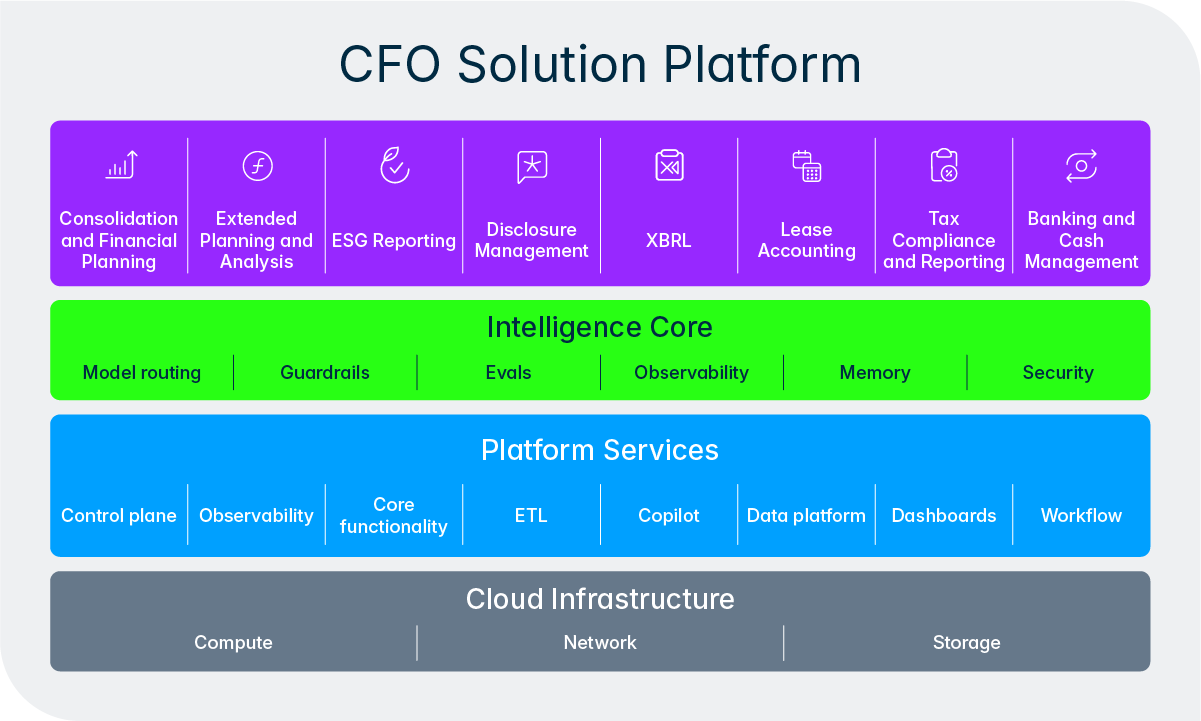
When Lucanet built its CFO Solution Platform, we built the foundation of what is now the best possible starting point for making AI available in a secure, scalable, and reliable way. Intelligence is now a core layer of our CFO Solution Platform architecture, not just added on the side.

Our approach separates five layers: 

  • Data layer: extracting, transforming, and loading data from heterogeneous sources, creating a single source of truth. 
  • Semantic layer: adding context to the data and making it understandable by AI.
  • Intelligence layer: adding reasoning, observability, guard rails and the ability to use tools.
  • Deterministic layer: deterministic business logic to execute and calculate.
  • Conversational layer: keeping humans in the loop and in control.


Intelligence is embedded across the platform: consuming the data, classifying the exception, drafting the narrative, surfacing anomalies. It exists in a secure and isolated environment – controlled and certified. The users are always in control, overseeing, coordinating and reviewing what work AI does: this is by design.


Evaluation

Most software development asks: does the feature work? Intelligence development has to ask: does the feature still work, on this customer's data, in this regulatory regime, this week? Our development discipline is built around continuous evaluations – replicating answers, scoring them against known-good outputs, shipping only what crosses the bar.
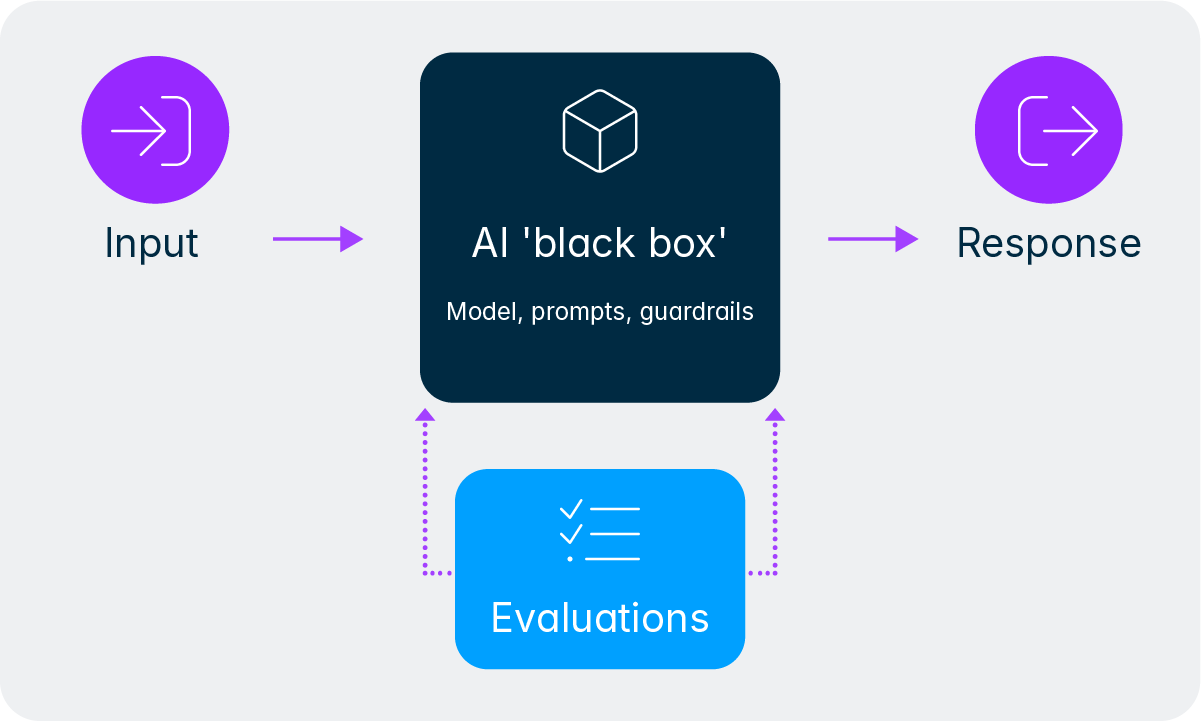
Evaluations (evals) are the secret sauce to building high quality AI capabilities. At Lucanet we develop our AI capabilities using an eval-first development approach. Evals consist of source material with ‘golden answers’ and a rubric that domain experts can apply repeatedly. Evals persist across different generations of models to ensure that as new models are used, the quality of the AI capability continuously improves. They are genuinely hard to master, but the only way to get high quality AI results – this is why we invest a disproportionate amount of effort into evals.


Domain

Over 25 years of finance and tax expertise sits inside our deterministic solutions: diverse local GAAPs, IFRS, ESEF, CSRD, Pillar 2. That expertise does not disappear when intelligence enters the picture. It becomes the floor intelligence stands on. A capability that knows how a German group consolidates a Japanese subsidiary under IFRS is a different animal from a general-purpose assistant that has read about it on the internet.

Lucanet is serving more than 6,000 customers worldwide, from the Americas to Europe to Asia, from start-ups to midmarket to listed enterprise and Fortune 500. Such a global footprint comes along with responsibilities: speaking the local and functional language, understanding diverse regulations, and still delivering a unified value proposition that keeps up with its promises.

Today, we count more than 180 partners in our global ecosystem including the Big4, leading ERP and accounting software vendors, international professional service groups, and midmarket boutique setups. These alliances enrich our go-to-market, level up our functional depth and extend our reach to our customers around the globe. Our partners sell, implement, consult, and support our solution offering because they consider innovative technologies like our CFO Solution Platform the ideal answer to the increasing complexity that the office of the CFO is facing in a fast-moving business environment.

We believe in standardization and automation, and we have a track record of delivering the latter to more than 50 countries worldwide, with the ability to still thoughtfully respect and consider any local requirements that might be singular from a global perspective but non-negotiable from a compliance standpoint.

"We built the Intelligence Core into the CFO Solution Platform as a core platform architecture layer, not added on the side as an afterthought. All of our AI capabilities are built on top of it. The Intelligence Core serves as our trust architect as it relates to AI capabilities. At Lucanet, ensuring trustworthy AI is non-negotiable.

Each AI capability is developed using an eval-first development approach. Evals are genuinely hard to get right, but an absolute must when building enterprise-grade AI capabilities that can meet the high demands of the office of the CFO. Every intelligent capability that we ship has a corresponding set of evaluations: a mix of qualitative and quantitative tests, a body of source material with its corresponding ‘golden answers’, and a rubric to score the outcome. Evals are run after every change – whether it’s a code, prompt, or regulation change, or even a new AI model, evals ensure the quality only goes in one direction – up.

Deterministic logic is used where finance and tax demand it. Finance and tax teams are accountable for the numbers – they need to be 100% correct, 100% of the time. AI is probabilistic in nature and so not suitable to perform deterministic calculations, but it is exceptionally good at reasoning, interpreting, and explaining. That’s why on the CFO Solution Platform, the division of labor is clearly separated: the platform performs deterministic financial calculations, whilst AI provides the reasoning, interpreting, and explaining.

Governance is built into the platform, not bolted on. When building the Intelligence Core, we carried forward the same high standards and design philosophy that we used when we built the CFO Solution Platform itself. Auditability, observability, traceability, data sovereignty are properties of the core architecture and hence are carried forward with all AI capabilities. For users to build trust with AI, they need to be in full control, they need to be able to see what AI is planning to do, observe what it is doing, and even course-correct if necessary – just as they would with a new colleague. Our AI capabilities are designed with this in mind, always with the human in the loop, so users remain in full control.

This is the less glamorous part of the story. But it is also the part that decides whether intelligence in finance and tax becomes a real product category or stays a demo reel."


Kevin Smith

Lucanet CTO


From fixing jobs to be done to running workflows

With the next wave of innovation launches, Lucanet will turn its CFO Solution Platform into the Intelligent CFO Solution Platform – doubling down on the automation of high-friction and high-frequency jobs to be done across finance and tax. It’s what we’ve always done, but now using the full range of what AI has to offer, all while remaining compliant and keeping a human in the loop.

This is where our customers will recognize a shift in how they use our platform.  

For most of our history, finance and tax processes and thus software products were organized around isolated jobs: a consolidation tool, a planning tool, a disclosure tool, a tax tool. Each has set a standard. But each is part of a larger workflow. And the seams between them are where the work shifted to – and where the friction, the bottlenecks, the delays, and the conflicts continue to pile up.

At Lucanet, we started to acknowledge the shifting bottlenecks with our move from point solution to platform offering. The CFO Solution Platform is an intentional sequencing of jobs to be done to complete end-to-end workflows, where each can run across one, up to three, or even four of our platform solutions. How did we get there? By listening closely to our customers!

Intelligence makes those seams addressable. It turns our platform into the Intelligent CFO Solution Platform, where the unit of work becomes the workflow:

  • Close: Closing the books pulls data, validates intercompany, posts corrections, reconciles, consolidates, drafts commentary and disclosures.
  • Plan: Planning refreshes the model on top of the close, surfaces variance, creates scenarios, drafts the narrative for diverse stakeholders. 
  • Report: Reporting pulls the plan and the actuals, drafts and tags the disclosure, checks consistency across narrative and numbers, files the report.


This shift redefines what our platform is for: workflows the platform runs with finance and tax teams in the loop, instead of a shelf of standalone tools your team picks from one at a time.


System of action, since 1999 

Since Lucanet was founded over 25 years ago, we’ve earned agency from thousands of customers worldwide. Agency that today empowers all our software solutions to securely execute tasks in the name of our customers using their high-fidelity financial and tax data.

Today and in the future, we want to extend that agency – to end-to-end workflows. Our Intelligent CFO Solution Platform provides the trust layer for cyber security, data governance, and compliance. 

The Intelligence Core adds the shared intelligent layer on top of which all current and future workflow agents run, inheriting the same properties by design: human in the loop, guardrails, data sovereignty. It enables calculations to be performed using deterministic logic, while intelligence is used for reasoning. 

This architecture is how Lucanet doubles down on clear differentiation and the uniqueness of our value proposition – while staying true to our core product principles.

As we move along, we will see a steep learning curve on all sides. Technology is ready and the impact becomes increasingly tangible as adoption is rising. This is the honest shape of bringing intelligence into a category where buyers always expect to see evidence first.

“Simply intelligent” was a groundbreaking principle in 1999. 

In 2026 it is a higher bar than it has ever been – and the one we intend to keep clearing.


Want to see Lucanet's Intelligent CFO Solution Platform in action?

Join our webinar to get an exclusive preview of the next generation of workflow agents coming to the CFO Solution Platform. 

Register now

  • Image of Elias Apel

    Elias Apel

    CEO, Lucanet

    After studying business administration in Ingolstadt (Germany) and Nice (France) with specializations in international management, accounting and controlling, Elias Apel spent more than a decade working in mergers and acquisitions and corporate finance consulting. In 2018, he took on the responsibility of expanding the international partner channel for Lucanet and in 2020 for all international go-to-market activities in existing as well as new growth markets.

    Elias joined the Lucanet board in May 2022 as CFO before transitioning into the role of CEO in October 2023.

  • Image of Kevin Smith

    Kevin Smith

    CTO, Lucanet

    After studying engineering at undergraduate and postgraduate levels, Kevin worked as a software engineer at IBM and then Microsoft. At Microsoft he was a Technical Lead software engineer in Redmond, WA where he shipped several software products and was awarded six software design patents for his work. He went on to spend 10 years building derivatives trading platforms for large investment banks before working for Fastmarkets as CTO and then Hg Capital as a Portfolio CTO.

    Kevin is experienced at building world-class SaaS platforms from the ground up as well as transforming on-prem software to SaaS. He has extensive experience building and scaling high performing engineering teams deployed both on and near shore. As Lucanet’s CTO, Kevin is responsible for technology, engineering, product and IT.

Contact Us