
We’ve covered a lot of ground so far in this series about the foundations of our CFO Solution Platform. What makes it powerful, trustworthy, and deserving of a place in your processes. All crucial elements, but complex and deep below the surface. So today we’re turning our attention to the very top layer: how you interact with it. And why it was the time to give it a clearer name.
A name that described the interface, not the system
For a while, the conversational layer on our CFO Solution Platform was called Lucanet Copilot. The name was accurate enough for where we started: a capable assistant sitting alongside your work, good at answering questions, helping you navigate, offering suggestions. You asked, it helped.
"Copilot" was an apt description of the interface, but we wanted to encompass the system behind it.
A copilot assists. It sits beside the pilot and hands over information. The pilot still flies the plane. That framing made sense when the conversational layer was not taking elaborate action, just surfacing reactive insights upon your request. For example, the Copilot helped you when you had questions on how to use the CFO Solution Platform and wanted to create new entities. It no longer makes sense when the conversational layer is the entry point to an Intelligence Core that plans, reasons, calls deterministic calculation engines, and orchestrates multi-step workflows across the platform.
The name was underselling the architecture. More importantly, it was setting the wrong expectations for what finance and tax teams are actually getting.
What the conversational layer is, and what it isn't
The conversational layer is a straightforward entry point to the CFO Solution Platform. It's where you describe what you need in plain language, and it’s what routes your request to the right capability for the job. However, it’s not the intelligence itself, and this distinction matters.
The Intelligence Core, which Kevin described in detail in edition #2, is the foundation. It holds the trust architecture: human-in-the-loop checkpoints, observability, guardrails, and data sovereignty. The conversational layer sits on top of that foundation. It's how you reach it. It's the front door.
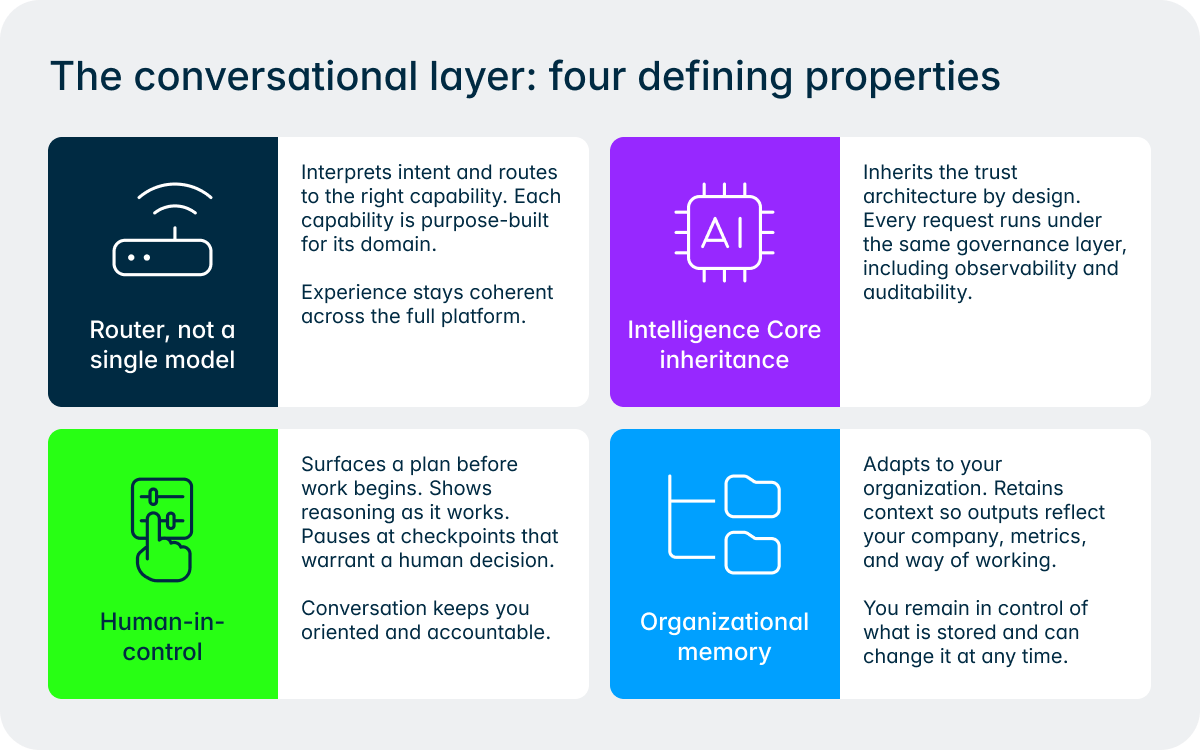
Four things define how that front door works
It's a router, not a single model trying to do everything. The conversational layer understands what you're asking for and directs it to the available capability that’s best suited for the task. Each capability is purpose-built and deep in its own domain. The conversational layer is what connects you to the right one and keeps the experience coherent as you move across the platform.
For example, the question "how did our business perform last month in comparison to FC 6+6 and year-over-year?" needs a different capability in the background than the prompt "create me a headcount planning model including social security contribution calculations by country". The cognitive load of deciding what capability and solution to use does not sit with you – it is handled by the routing in the conversational layer.
It inherits the Intelligence Core's properties by design. Everything you access through the conversational layer runs on the same trust architecture. There's no separate, less-governed "chat mode." The convenience and the trust guarantees are part of the same surface.
It keeps you in control. The conversational layer surfaces a plan before work begins, shows its reasoning as it works, and pauses at the checkpoints that warrant a human decision. The conversation is how you stay oriented and how you stay accountable.
It becomes attuned to your organization. The conversational layer can save information you provide to its memory. This means that when you analyze last month's business performance, your company’s context is taken into account, reflecting your industry and key metrics rather than generic AI responses. You stay in full control of what is stored and can update it at any time.