For the full technical picture, including how evals work and how guardrails are built, see Intelligence inside #2: Building Lucanet's trust architecture.
Does this mean Lucanet is becoming an AI-only company?
No. But we are embracing the opportunities that AI brings.
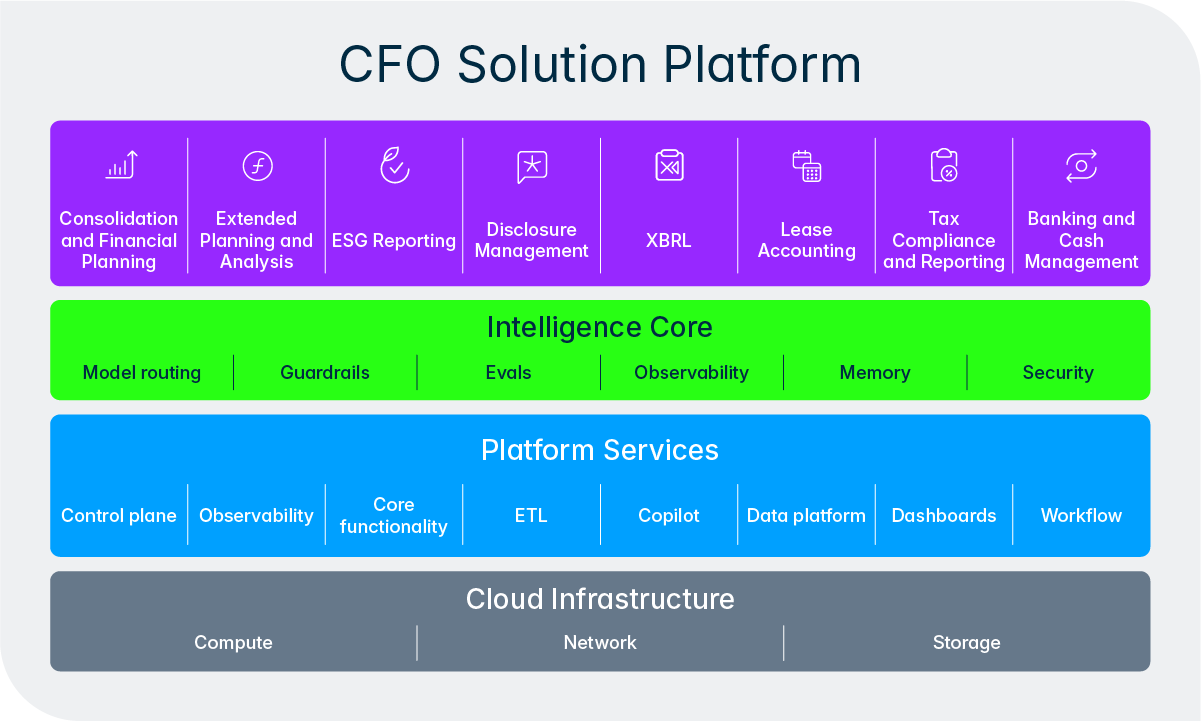
The CFO Solution Platform, its deterministic solutions, and its 25-plus years of finance and tax expertise remain the foundation. Intelligence is being built into that foundation, not layered on top of it.
It helps to be clear about what's changing and what isn't. The workflows your team runs today are the same workflows the platform is now automating with greater intelligence. The path is familiar. The companion walking it with you is new.
Your existing solutions are not being deprioritized. The tools you use to close, plan, and report aren’t going anywhere, and will continue to produce reliable, auditable results. Workflow agents enhance what already works. They don't replace it.
Will workflow agents take over my job?
No. And that's not a hedge.
Human-in-the-loop is a design principle at Lucanet, not a disclaimer added after the fact. In practice, agents surface their plans before they act. They pause at critical checkpoints: before posting a journal entry, finalizing a disclosure, or submitting data to a regulator. They keep a full audit trail of every decision. Your team stays accountable for every number.
There's a useful way to think about this. Imagine you've just hired someone with extraordinary reasoning ability and deep knowledge across many domains, but it's their first day on the job. Over time, as that colleague proves reliable, you choose how much to delegate. The authority always stays with the people accountable for the output.
This is a strategic advantage, not a threat. Intelligence removes the manual, repetitive burden that eats your team's time. That frees finance and tax professionals to focus on the work only they can do: interpretation, judgment, and communicating with stakeholders.
How do I know the numbers are accurate?
Start with the core design principle: financial calculations are never performed by a large language model (LLM).
LLMs are good at reasoning calculations. They are unreliable at performing them. So Lucanet built that distinction into the Intelligence Core. The intelligence decides what needs to be calculated and why. Deterministic logic, such as your consolidation and planning calculation engines, does the actual arithmetic and returns a precise result. Every number traces back to a validated engine, not a probabilistic guess.
Accuracy is also enforced through how agents are built. Lucanet uses an eval-first development approach: automated tests grade an agent's output against a rubric at every step, so quality is driven up systematically before anything reaches you. For the details on how evals work, including why a 90% accuracy rate per step isn't good enough, see edition #2 of this series.
Then there's observability. Every step in an agent's reasoning is logged and traceable. You can see which data sources it used and how it reached its conclusion. "The AI did it" is never the answer. You can show your working to an auditor, because the working is right there.
Is my data safe?
Yes. Data sovereignty is built into the foundation.
Each customer's data sits inside its own isolated tenant. The Data Platform inherits Lucanet's strong isolation model, so one tenant can never see another tenant's data. Your raw data, your cleansed data, your knowledge graph, and your agent memory all stay inside your tenant, encrypted in transit and at rest.
The LLM boundary matters too. When an agent uses a model to reason, only the data strictly needed for the task is passed across. Lucanet uses models hosted in the EU for EU customers, and under its enterprise agreements with model providers, prompts and responses are neither retained nor used for model training.
This is backed by certifications, not claims. Lucanet holds SOC 1, SOC 2, ISO 27001, ISO 27017, and ISO 27018. ISO 42001 (the international standard for AI management systems) and BSI C5 (the German government's benchmark for cloud security) are both expected by summer 2026. The platform also aligns to the EU AI Act, NIS2, the upcoming Cyber Resilience Act, and supports operational resilience requirements for customers in DORA-regulated environments.
For the full Data Platform and security architecture, see edition #3: Lucanet's Data Platform and the semantic layer.
What's already shipped, and what's coming next week?
Intelligence at Lucanet is not future-dated. It's already in production and in use.
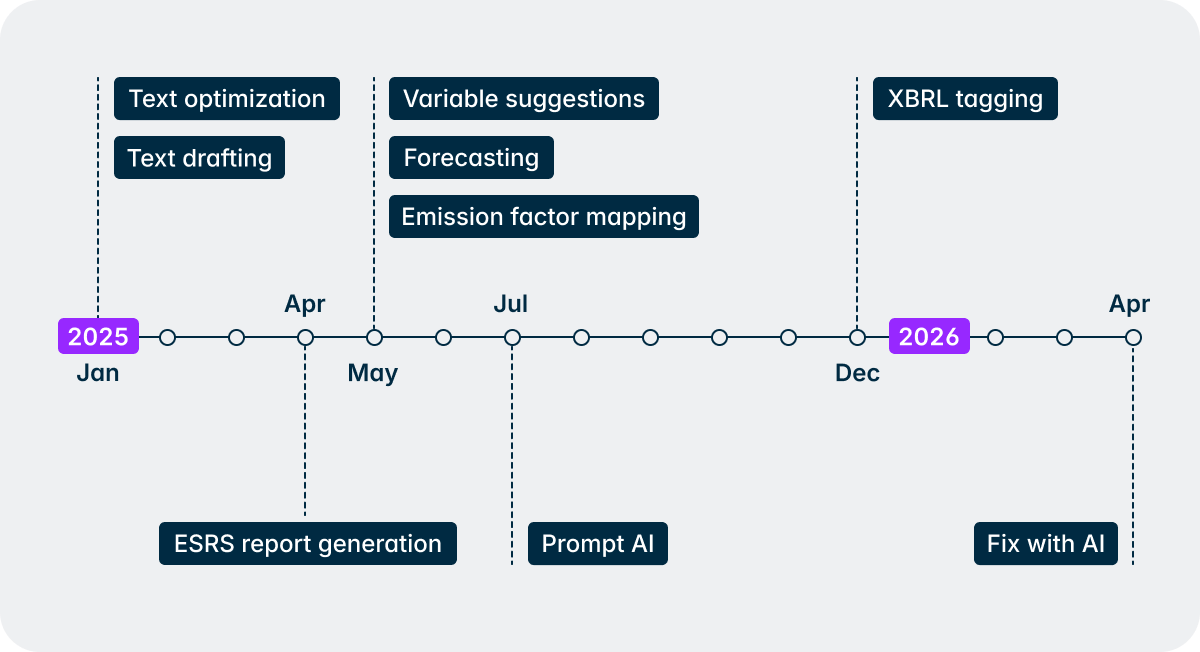
Over the past year, intelligent features have shipped across the platform: AI-assisted financial modeling in xP&A, automated emission factor mapping in ESG Reporting, taxonomy-compliant drafting in Disclosure Management, and the Tagger Agent for XBRL filing, the first comprehensive AI agent for XBRL reporting in the market. For the full rundown of what's live, see episode #4: Shipping finance-grade intelligence.