AI is reshaping the talent landscape in finance. Here’s what you can do to strengthen your team

Published Jun 08, 2026  | 5 min read
  • Image of Lucanet

    Lucanet

AI raises the bar for the skills teams need across finance. Many leaders see the potential of AI. The harder part is building the capabilities required to use it well. 

This article looks at why AI adoption often stalls, where skill gaps are emerging, and how finance leaders can build a team that actually delivers value with AI.


AI skill gaps are one of the biggest barriers to business transformation

Research from the World Economic Forum shows that skill gaps remain the single biggest barrier to business transformation. The same research points to AI and big data as some of the fastest-growing skill areas through 2030, with 59 out of 100 workers expected to need reskilling or upskilling by the end of the decade.¹

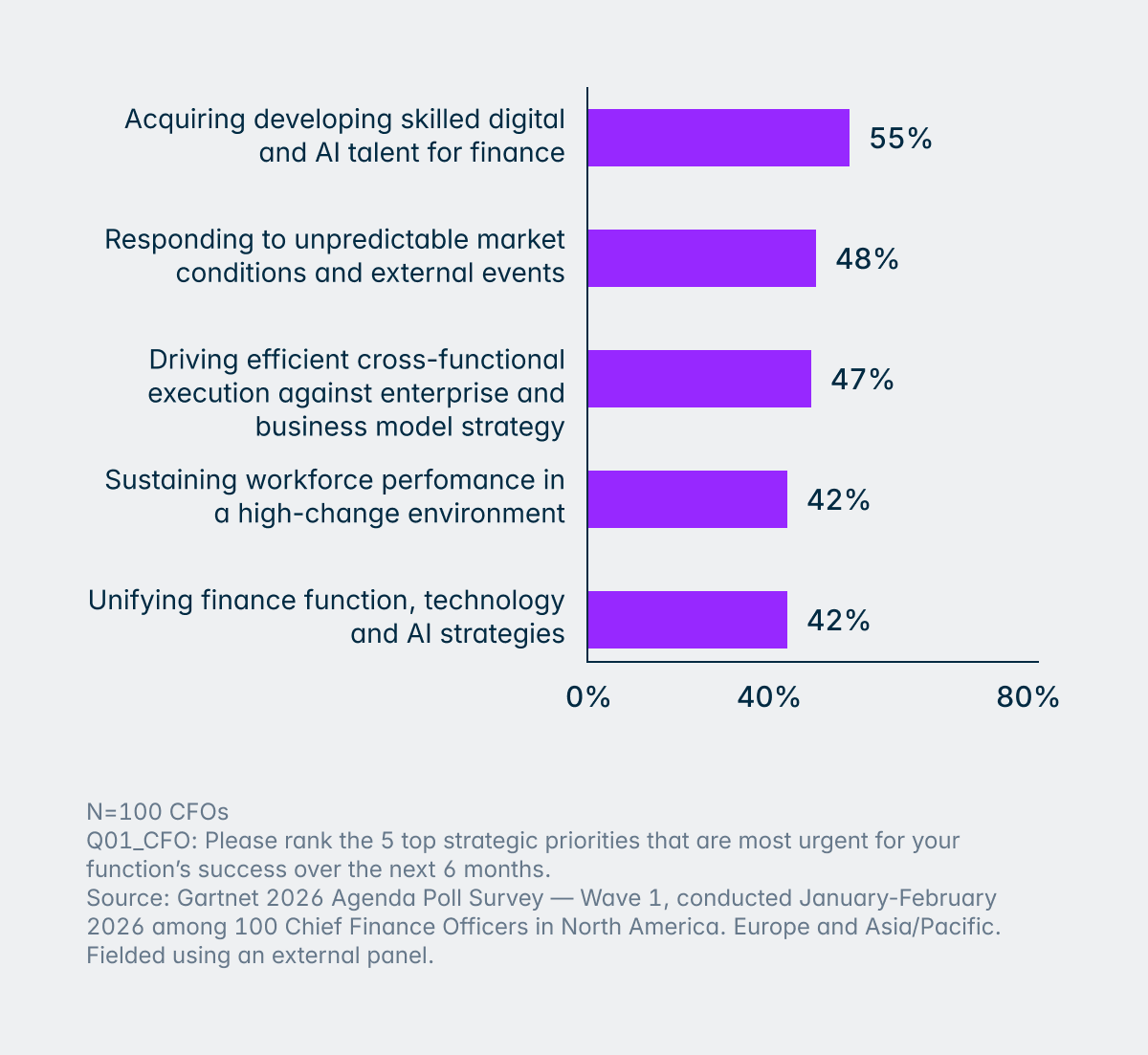
Finance teams are already feeling this pressure. Gartner reports that building AI and digital talent is now one of the top near-term challenges for CFOs.²

Top near-term challenges for CFOs GARTNER

At the same time, fewer than half of finance leaders say they are confident they can accelerate AI adoption or hire and retain the talent they need.³


Why “but we are already using AI” is not enough

Many finance teams – yours probably too – are already experimenting with AI. Adoption is increasing, but maturity is still low.

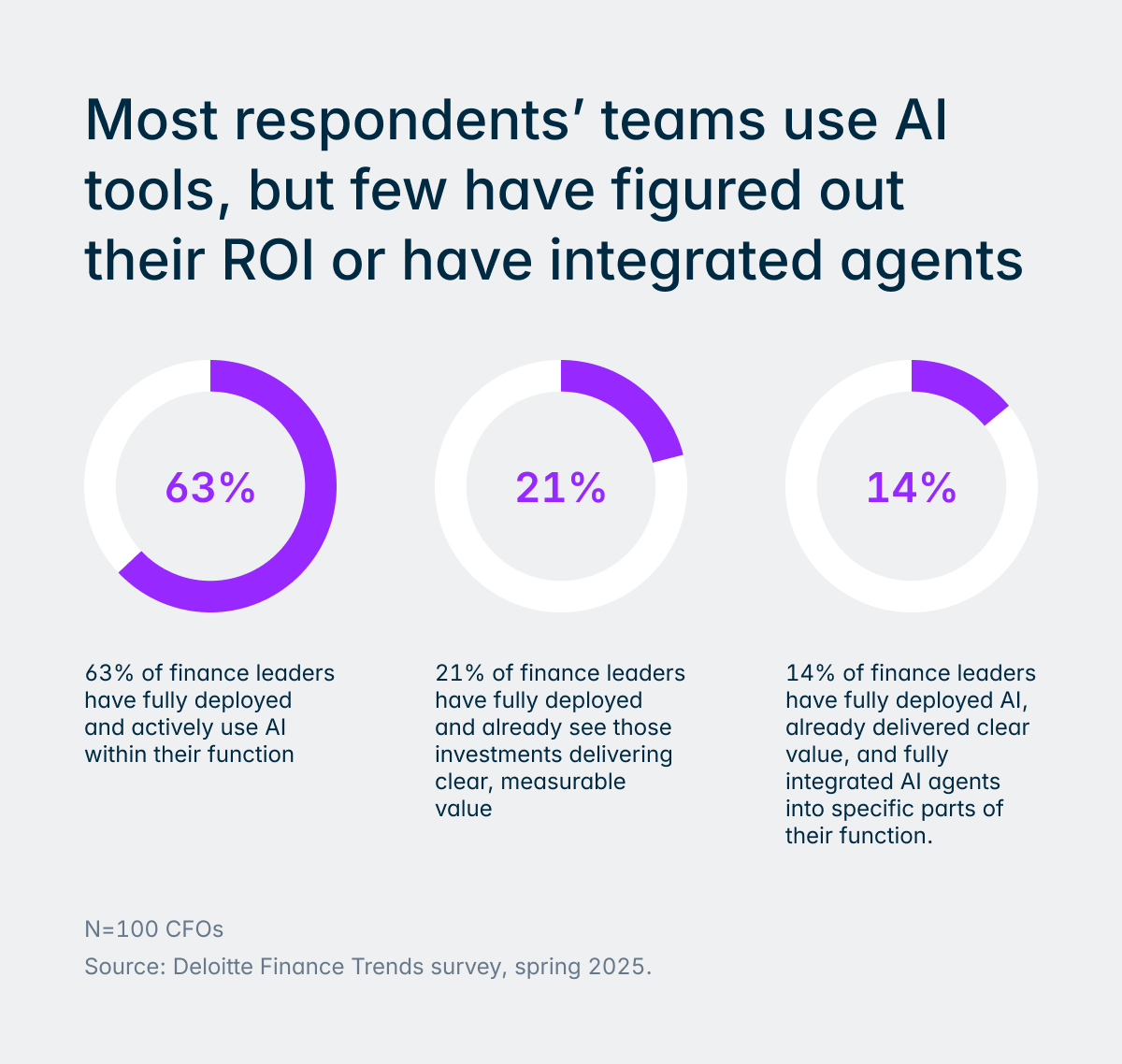
According to a global finance survey conducted by Deloitte, 63% of respondents said they use AI in finance. However, only 21% said these investments have provided clear, measurable value.⁴

Global finance survey results conducted by Deloitte DELOITTE

Returns are often modest, and many teams struggle to measure them. Why?

One common reason is how AI is introduced. Many teams run isolated pilots or test individual tools without a clear plan for scaling. 

Teams see better results when they define what “good” looks like for AI in finance, and then build a step-by-step plan that covers data quality, governance, skills, and day-to-day processes.


There is a growing mismatch between AI expectations and workforce readiness

According to the PwC Global AI Jobs Barometer⁵:

  • Skills in AI-exposed roles are changing 66% faster than in other occupations 
  • Workers with AI skills earn a 56% wage premium on average 


Hiring behavior reflects this shift:

  • Around two-thirds of leaders would not hire candidates without AI skills 
  • A similar share would choose less experienced candidates with AI skills over more experienced ones without them


At the same time, according to Deloitte⁶, only 39% of employees who use AI at work say they have received training from their employer. 

Many teams are still building the capabilities they need while expectations continue to rise.

Recent research reflects this tension: 36% of employees say they feel pressure to use AI even if they do not fully understand it, and a growing share report signs of AI fatigue.⁷


So where should you start? Three practical steps

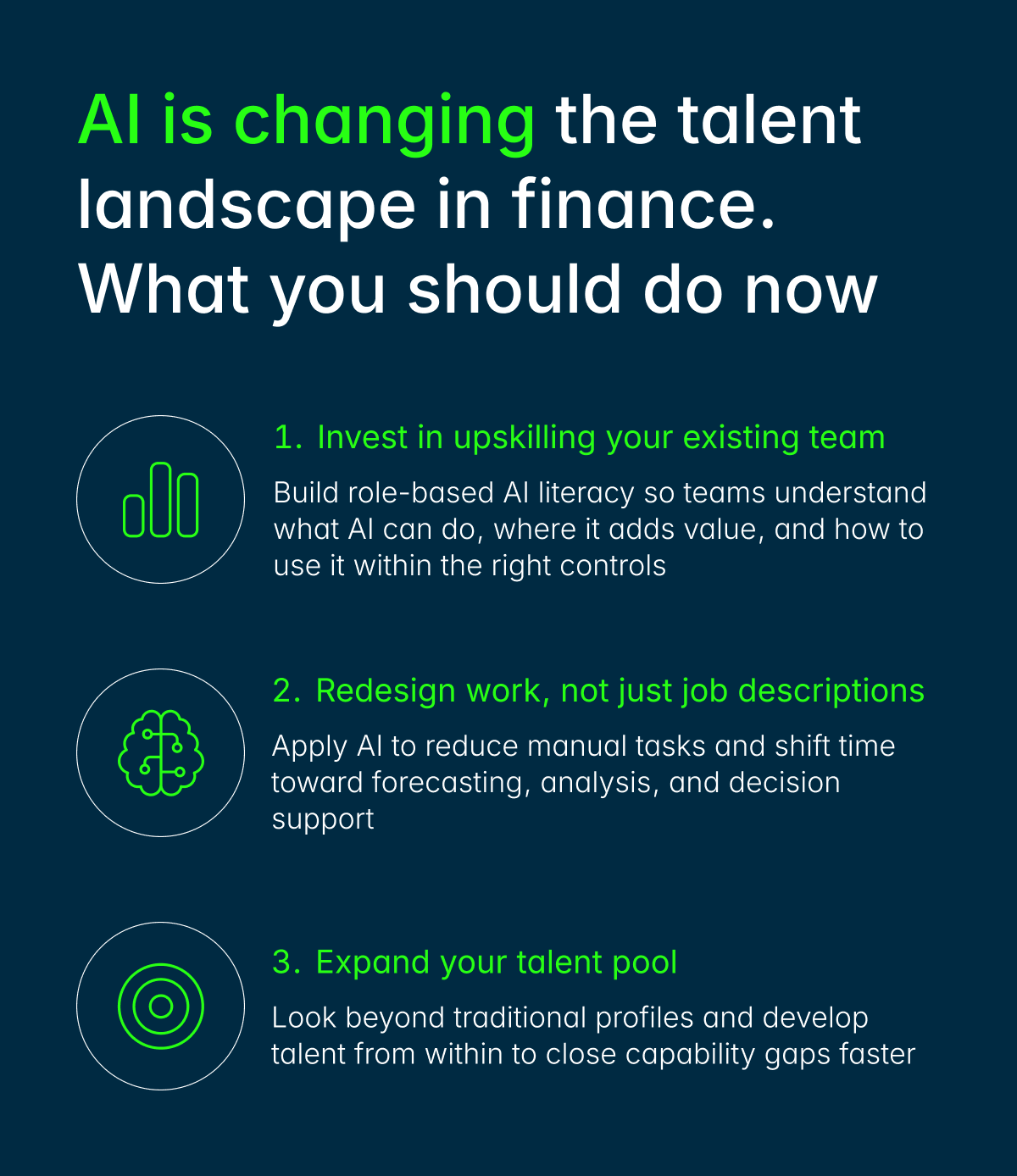
AI is changing the talent landscape in finance. What you should do now

Step 1: Invest in upskilling your existing team

Most organizations will not solve this problem through hiring alone. The external market for AI talent is tight, and finance-specific expertise is even harder to find.

Many leaders are focusing on upskilling instead. In practice, that means building role-based AI literacy. Different groups need to understand AI, what it can and cannot do, and how to use it within the right controls.

The depth will vary by role. Finance business partners need to see how AI supports forecasting and decision-making. Accounting teams need to know where automation reduces manual work and where controls still apply. Tax teams need to understand how AI supports data analysis and compliance processes.


Step 2: Redesign work, not just job descriptions

AI is most useful when it removes repetitive, low-value tasks and frees up time for forecasting, analysis, and decision support.

In finance, the highest-impact use cases often sit in forecasting, risk, statutory accounting, and workflow-heavy processes. In tax, teams usually start with routine data tasks, analysis on top of ERP systems, and targeted pilots in compliance processes.

The focus should be on applying AI where it changes how work gets done. The aim is to shift human effort closer to decisions and insights that affect outcomes.


Step 3: Expand your talent pool

The future finance team will not come only from traditional accounting or tax career paths.

Some organizations are already hiring from adjacent areas such as data, engineering, or process design. Others are building internal pipelines through rotations and cross-functional moves.

This is especially relevant in tax, where talent shortages are structural. Expanding the talent pool and reducing time to productivity through better tools and training will matter more than finding “perfect” candidates.

You need to look beyond traditional hiring channels and rethink how quickly people can become productive with the right tools and training. Your next strong finance hire may already be in your company, working in a different function.


AI in finance only works if you can trust the output

Finance teams are accountable for their numbers in front of management, auditors, and regulators. AI does not change that. Therefore, you still need reliable data, clear controls, and systems that align with your team's workflow.

That's where Lucanet can really support you. Our CFO Solution Platform combines traditional financial processes with AI capabilities within a single environment.

It covers areas such as planning, consolidation, disclosure management, and ESG reporting, with a focus on reducing manual effort and giving teams a clearer, more consistent data basis for strategic decision-making.

If you want to see what this looks like in practice, and how AI can support your day-to-day finance work:


Get to know Lucanet

  • Image of Lucanet

    Lucanet

    Lucanet is a global software provider for financial consolidation, planning, and reporting. Our user-friendly CFO Solution Platform is designed to match the exact requirements of finance teams by providing accurate and consistent information effectively. For more than 20 years, 6,000+ customers in 50 countries have already trusted Lucanet.

Contact Us