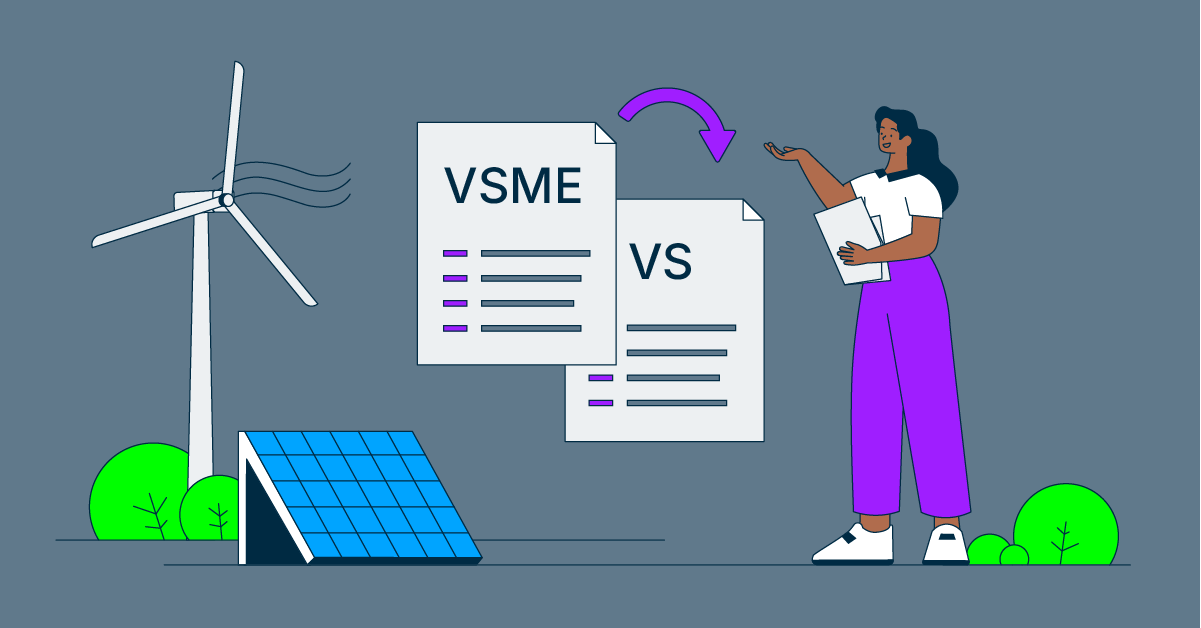
Renunciation of a double materiality assessment as a key simplification
One of the main simplifications compared to reporting under the European Sustainability Reporting Standards (ESRS) is that the VS does not require a double materiality assessment. This removes a process that often involves considerable methodological and organizational effort for companies.
Instead of implementing a double materiality assessment, the VS introduces a catalogue of information that must generally be reported, supplemented by the "if applicable" approach. That means, that certain disclosures only need to be made if the underlying issue or topic is actually relevant to the company in question. That said, this does not fully exempt companies from assessing which sustainability topics connect to their business model and activities.
A word of caution here: The VS does not additionally distinguish, for these disclosures, whether an applicable issue or topic is also material. As a result, sustainability data may be subject to reporting obligations even where it is not material for the company. Whether this approach proves workable in practice is likely to be one of the interesting questions of future reporting periods.
Data point categories: what counts in practice
For practical implementation, the differentiation of data point categories introduced in the final version of the VS is particularly important. Alongside generally required data points, the standard includes disclosures that are only required if applicable, explicitly voluntary data points, and data points for additional sector-specific information.
For companies with 10 or less employees, the standard provides further relief. Certain data points do not need to be disclosed without this resulting in a loss of module conformity.
The voluntary decision to apply the VS should not be confused with a reporting that is entirely arbitrary. If a company decides to apply a module, it must, in principle, comply with that module's required and applicable data points.
The Value Chain Cap as a protection mechanism against trickle-down effects
The VS is considered to have significant practical relevance in combination with the so-called Value Chain Cap. This mechanism is designed to prevent companies subject to the CSRD from effectively passing their own reporting burdens on to non-reporting companies in their value chain through extensive information requests.
Protection applies, in principle, to non-reporting companies with 1,000 or less employees that form part of the value chain of a reporting company. What matters is not whether the protected company itself produces a VS report. The mechanism limits, rather, what information may be requested for the purposes of CSRD reporting.
This can provide significant relief for companies, as data requests made for CSRD reporting purposes that go beyond the defined scope may be rejected under certain conditions.
Limits of the Value Chain Cap
In practical application, what will matter most is the reason a business partner is requesting sustainability data. The Value Chain Cap only applies to information requests made for the purpose of sustainability reporting under the Accounting Directive. Where the same or more detailed information is needed to fulfil due diligence obligations, for credit risk analysis, risk management, or sustainability controlling, this limitation does not apply.
Furthermore, companies subject to the CSRD sometimes require product- or future-related information at a level of detail not covered by the Value Chain Cap. The standard will therefore not be able to fully replace individual data requests within the value chain.
What companies should take away from the VS
The VS has the potential to significantly standardize voluntary sustainability reporting. For companies that regularly supply sustainability information to banks, customers, or other business partners, having a standardized data set can meaningfully reduce the workload.
At the same time, the VS should not be seen as a guarantee, in future, companies will only have to complete a single sustainability questionnaire. Its practical effect depends heavily on whether the various users of sustainability information also adopt the VS as a benchmark.
For sustainability managers, it is worth viewing the VS not only as a reporting standard. It can also serve as a structural template for internal sustainability data management: what information is already available? What data needs to be collected systematically in the future? Which requests fall under the Value Chain Cap, and which pursue other objectives?
These are the questions that will determine whether the VS becomes, in practice, what it is meant to be: a proportionate yet interoperable framework for voluntary sustainability reporting.
Meeting regulatory requirements in ESG reporting
A structured ESG reporting system helps you capture data points systematically, meet module requirements, and prepare your sustainability data consistently for different stakeholders. This puts you in a strong position for whatever new regulatory requirements lie ahead.
Lucanet ESG Reporting