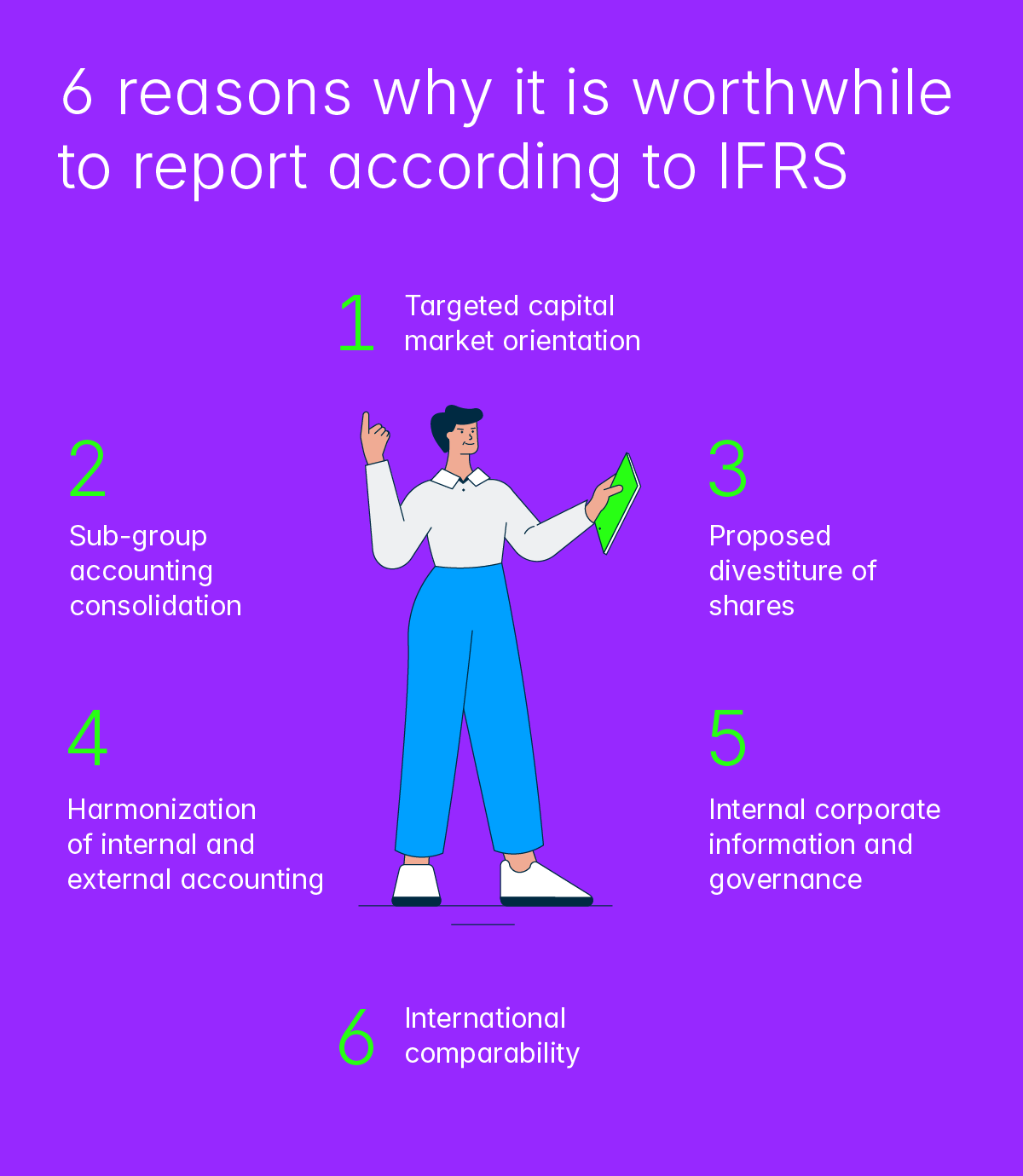
Reason 1: Targeted capital market orientation
If a group plans to use the capital market in the future, many countries require IFRS to be used in reporting. This applies, for example, to parent companies based in the EU that are seeking access to the EU capital market, which have to prepare their consolidated financial statements in accordance with IFRS.
The situation is similar when a parent company based in Germany is trying to get listed on the New York Stock Exchange (NYSE). To get approval, it could prepare its consolidated financial statements in accordance with the US GAAP or IFRS. Since the company is based in Germany and does not use the EU capital market, it can choose between German GAAP and IFRS.
However, consolidated financial statements prepared using US GAAP would require additional financial statements prepared in accordance with German GAAP or IFRS. But because a company can obtain a stock exchange listing in the USA with IFRS financial statements, IFRS is a more practical and economically viable solution in this case.
Reason 2: Subgroup financial statements
If a parent company has so far reported under national law and is then acquired by a group that already reports in accordance with IFRS, then some new adjustments will be needed.
In future, the company acquired needs to provide IFRS-compatible data so that the new parent company can fully prepare its consolidated financial statements in accordance with IFRS.
If the company acquired still needs to continue preparing its own consolidated financial statements (even in part) and no exemption applies, it may be useful to convert the information to IFRS as well. This avoids duplicated efforts and makes reconciliation easier between subgroup financial statements and consolidated financial statements of the entire group.
Reason 3: Planned sale of shares
If a group is putting itself up for sale or selling shares in it, an IFRS transition can offer strategic advantages. Depending on the type of potential buyer, it's worth taking a closer look:
- Private investors, especially domestic ones, don't usually have a preferred accounting system.
- Institutional or international investors, on the other hand, often expect IFRS financial statements so they can better compare the company with others.
- If an acquiring entity prepares its own financial statements in accordance with national law, it will generally prefer financial statements prepared in the same way – unless it also uses IFRS in its consolidated financial statements.
An IFRS transition can provide more transparent key figures that make it easier to realistically assess the company. However, the costs of a transition should be carefully considered if the planned sale is the only motivation.
Reason 4: Harmonized internal and external accounting
In many areas, IFRS regulations lead to valuations that are closer to market conditions than national accounting regulations – especially in EU countries in view of the principle of prudence that prevails there.
Examples of this are:
- Fair value measurement of financial instruments or investment properties
- Discounting of long-term provisions at the interest rate applicable on the reporting date
- Depreciation that is more closely aligned with actual usage
- Prohibiting the LIFO (Last in, first out) method for inventory valuation.
This market-oriented perspective can prompt companies to use IFRS data internally for planning, management, and controlling.
This results in a unified database for internal and external reporting — with clear synergies and more consistent information across the entire group.
Subsidiaries that are fully included in the consolidated financial statements must prepare their reporting packages in accordance with the law that also applies to the consolidated financial statements.
If the group consists mainly of domestic companies, reporting according to national law may be practical.
The situation is different if the group includes many or predominantly foreign subsidiaries – or if it expects to expand abroad in the future. In such cases, IFRS accounting may make more sense, especially if IFRS is already mandatory or widely used in the countries concerned – such as the USA, China, or India.
Internal group management also benefits: A more market-oriented valuation in accordance with IFRS (see point 4) often eliminates the need for additional imputed variables.
Reason 6: International comparability
Many corporations – including those not listed on the stock exchange –operate globally in international procurement and sales markets, working with partners from various countries.
IFRS consolidated financial statements facilitate communication in these relationships: business partners, investors, and banks can more easily understand the figures and compare them with other companies.
This not only improves external transparency, but also confidence in the quality of financial information.
White paper: Getting ready for the IFRS transition
What does an IFRS transition actually involve? Which organizational steps are crucial? And what are the typical stumbling blocks?
Our IFRS white paper has the answers and explains how to make the transition to IFRS a smooth one.
Get the white paper