How the SPARK Matrix™ helps finance teams find the right intercompany solution
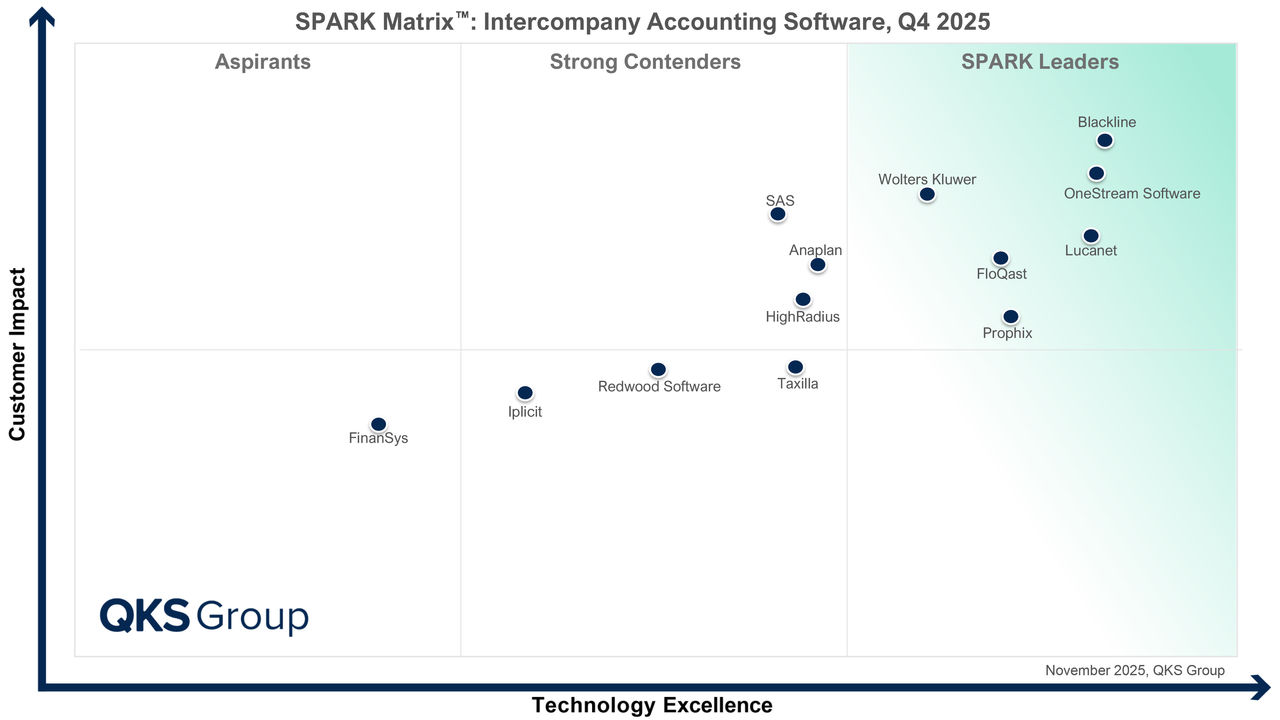
The SPARK Matrix™ Intercompany Accounting Software is an independent evaluation of vendors conducted by the QKS Group, a leading global advisory and research firm. The evaluation combines technology excellence with an assessment of customer impact.
For finance teams, this makes it easier to see where solutions differ, from architecture and automation to overall operational fit. As a result, you can narrow down your options before moving on to detailed demos or implementation projects.
6 intercompany accounting trends you should have on your radar
Before we dive in at Lucanet’s evaluation, let’s take a closer look at the six intercompany accounting trends identified in the report.
Trend 1: Cloud-native architectures become standard
Finance teams expect scalable systems with real-time access and smooth collaboration across entities and regions.
Trend 2: AI moves into core accounting workflows
AI supports reconciliation, detects anomalies, and enables more reliable forecasts. The result: less manual effort and more consistent data.
Trend 3: Specialized tools replace ERP customization
Instead of adapting ERP systems, many organizations introduce dedicated intercompany solutions that connect via APIs and streamline specific processes.
Trend 4: Real-time visibility replaces static reporting
Dashboards and integrated analytics are replacing spreadsheet-based reconciliations. Issues become visible earlier, and teams can respond faster.
Trend 5: Intercompany processes become continuous
Ongoing validation and approval and less reactive, month-end reconciliation support a smoother group close.
Trend 6: Compliance and risk management are no longer optional
Support for IFRS, local GAAPs, transfer pricing rules, and AI-based anomaly detection is now a baseline requirement for global organizations.
Inside Lucanet’s SPARK Matrix™ leadership
The QKS Group emphasizes Lucanet’s excellent technological capabilities and tangible customer impact.
This powerful combination shows up in many concrete ways:
Clear visibility from group level down to transaction detail: Finance teams can move from consolidated figures directly to the underlying transaction level without system slowdowns.
A data foundation built for control and traceability: Intercompany entries are stored in a structured transactional database that allows fast access, full traceability, and controlled netting and settlement processes.
Native integration with consolidation and planning: Eliminations take place within the same data environment, which reduces manual adjustments and supports consistency during group close.
Built-in compliance across accounting standards: Predefined rules for IFRS and multiple local GAAPs simplify work in multi-country environments and reduce the need for customization.
AI embedded in finance workflows: AI supports reconciliation, forecasting, and reporting with contextual insights and automated recommendations.
Perfect for small and mid-sized groups: The solution is tailored to organizations that operate across entities and jurisdictions but need a controlled, finance-owned system rather than a heavy enterprise IT project.
What Lucanet can do that other vendors can’t
Large enterprise platforms can offer breadth but typically require extensive configuration, long implementation timelines, and ongoing consulting effort. At the other end of the spectrum, highly flexible tools may demand significant technical expertise to maintain.
Lucanet takes a different approach:
- purpose-built for finance leaders in the office of the CFO
- focused on intercompany transparency, compliance, and control
- fast to deploy without sacrificing depth or audit readiness
Get the full intercompany accounting report
Want to take a closer look at how leading vendors are evaluated and which capabilities matter most for modern intercompany accounting? The full SPARK Matrix™ report provides a detailed analysis. See the full report here:
Get intercompany accounting report